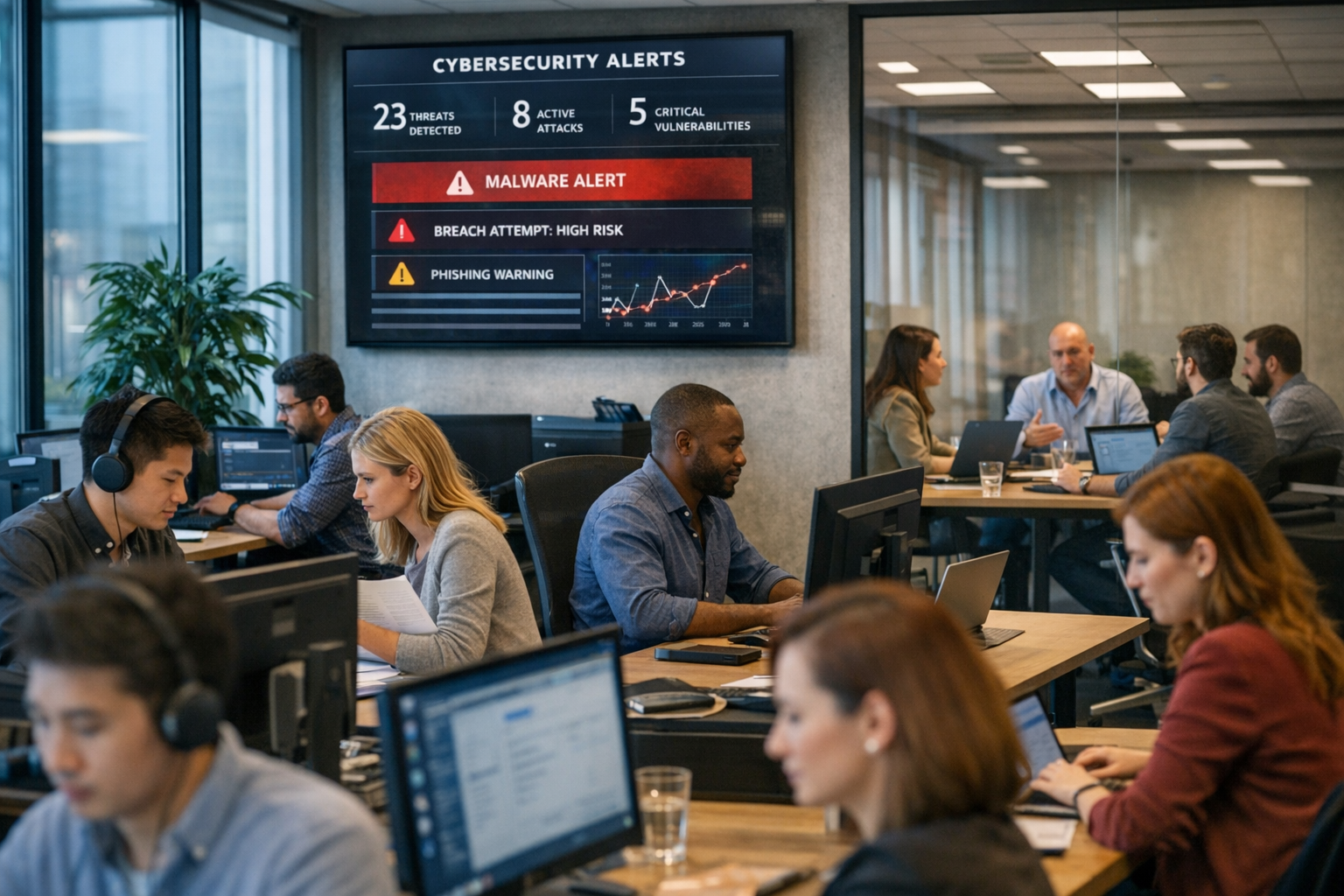
Ransomware in 2026: Not If, But When
Ransomware attacks hit businesses of every size in 2026. Here’s what the threat looks like today and how to protect your organization before it’s too late.
 By
Jason Lee
18 min read
By
Jason Lee
18 min read
Ransomware in 2026 is not a distant threat reserved for large enterprises. It targets businesses of every size, in every industry. Modern attacks encrypt your data, steal it, and threaten to publish it, often before your team notices anything is wrong. According to Verizon’s 2025 Data Breach Investigations Report, ransomware was present in 44% of all analyzed breaches, up from 32% the year prior. [1] The question is no longer if you’ll be targeted. It’s whether you’ll be ready.
What Is Ransomware, and Why Is It Still Growing?
Ransomware is a type of malicious software (malware) that locks you out of your own data by encrypting it. The attackers then demand a payment in exchange for the decryption key. If you refuse, or even if you pay, they may publish your stolen data anyway.
What makes ransomware so persistent is its profitability. Cybercriminal organizations operate like businesses, with customer service teams, technical support, and affiliate programs that let other bad actors deploy their tools in exchange for a cut of the payout. The barrier to launching an attack has never been lower. The potential reward has never been higher.
How Has Ransomware Evolved in 2026?
A few years ago, a ransomware attack meant one thing: your files get encrypted, you lose access. Today the playbook is more sophisticated and the damage is more lasting.
Double extortion is now standard. Attackers don’t just lock your data. They exfiltrate it first. Even if you restore from a clean backup, they can still threaten to release your customer records, financial data, or employee information unless you pay.
AI is accelerating the threat. Artificial intelligence has made phishing emails, the most common ransomware delivery method, harder than ever to detect. AI-generated messages now mimic real writing styles, reference actual company details, and slip past spam filters with ease. As we explored in AI in Cybersecurity: Mastering the Dual-Edged Sword, attackers are learning to use the same tools defenders rely on.
Backups are being targeted. Sophisticated ransomware groups often spend weeks inside a network before deploying their payload. During that time, they identify and corrupt or delete backup systems. When the attack fires, there may be nothing clean to restore from.
Are Small and Mid-Size Businesses at Risk?
Yes, and disproportionately so. According to the Verizon 2025 DBIR, ransomware was a factor in 88% of breaches affecting small and mid-size businesses, compared to 39% for large enterprises. [2] [Larger organizations tend to have dedicated security teams, incident response playbooks, and cyber insurance policies with real teeth. Smaller businesses often have none of those things, which makes them easier targets with less resistance.
The assumption that “we’re too small to be worth targeting” is one of the most dangerous beliefs in business today. Attackers don’t select victims based on size. They select based on vulnerability. As we discuss in Small Business Cybersecurity: The Wake-Up Call Every Owner Needs, the same tools and tactics used against enterprise targets are deployed against local businesses every day.
What Does a Ransomware Attack Actually Cost?
The ransom demand is the visible number, but it is rarely the largest expense. Sophos’ State of Ransomware 2025 report found the average cost to recover from a ransomware attack, excluding the ransom payment itself, was $1.53 million. [3] The full tab includes:
- Downtime: Lost productivity while systems are taken offline and restored
- Recovery costs: IT labor, forensic investigation, and incident response fees
- Reputation damage: Customer and partner trust that can take years to rebuild
- Legal exposure: Data breach notification requirements under state and federal law if customer data was compromised
- Cyber insurance gaps: Many policies exclude attacks resulting from unpatched vulnerabilities or missing controls like multi-factor authentication
The ransom payment itself is often smaller than people expect. The Verizon 2025 DBIR found the median ransom payment was $115,000, and 64% of affected organizations refused to pay entirely. [4] The more accurate measure of cost is everything that happens after the attack lands, regardless of whether you pay.
We saw the near-miss version of this play out in detail in Anatomy of a Thwarted Cyber Attack: Here’s What Happened. The businesses that don’t catch it in time face a far longer and more expensive road.
What Does a Ransomware-Resilient Business Look Like?
Resilience isn’t about being unhackable. It’s about being hard to hit, fast to detect, and ready to recover. Sophos found that 53% of organizations affected by ransomware in 2025 recovered within one week, up from 35% the year before.[5] The difference between them and the businesses still rebuilding months later comes down to preparation.
At Sentry, we guide clients through our Technology Maturity Model (TMM), which moves businesses from simply operating through securing, integrating, and ultimately innovating. Ransomware preparedness lives in the Secure stage, and it covers more ground than most business owners realize.
Layered endpoint protection. Next-generation antivirus and Endpoint Detection and Response (EDR) tools that don’t just scan for known malware. They monitor for unusual behavior and flag it in real time.
Tested, isolated backups. The 3-2-1 rule: three copies of your data, on two different media types, with one stored off-site and air-gapped from your environment so ransomware cannot reach it.
Access controls and zero-trust principles. Limiting what each user can access reduces the blast radius of any breach. If one account is compromised, attackers should not be able to reach everything.
Employee training. Most ransomware enters through human error. A clicked link. An opened attachment. Regular security awareness training transforms your team from a vulnerability into a first line of defense.
An incident response plan. Knowing what to do in the first 30 minutes of a confirmed attack can mean the difference between a managed recovery and a catastrophic one. If your plan isn’t written down and hasn’t been tested, it isn’t a plan.
Ready to Find Out Where You Stand?
Ransomware is a business continuity issue, and the time to prepare is before an attack, not during one. Sentry Technology Solutions works with businesses across 30+ states to close security gaps and build the kind of resilience that keeps operations running when the pressure is on. Schedule a consultation or take our TMM Assessment at sentryitsolutions.com
Frequently Asked Questions
Should I pay a ransomware demand?
The FBI and CISA advise against paying. Payment does not guarantee you’ll get your data back, it funds future attacks, and it may create legal exposure depending on who the attackers are. The Verizon 2025 DBIR found 64% of ransomware victims refused to pay, which reinforces that recovery without payment is increasingly viable for prepared organizations.
How does ransomware get into a business?
The most common entry points are phishing emails, compromised credentials from prior data breaches, unpatched software vulnerabilities, and poorly secured remote access tools like VPNs and Remote Desktop Protocol (RDP). Attackers also purchase access to already-compromised networks through dark web marketplaces.
Is cyber insurance enough protection?
Insurance transfers financial risk but does not prevent an attack or speed up recovery on its own. Insurers are tightening eligibility requirements. Businesses without multi-factor authentication (MFA), tested backups, and documented security controls may find claims denied or coverage limited when it counts most.
How long does it take to recover from a ransomware attack?
It depends almost entirely on how prepared you are. Sophos found that 53% of affected organizations in 2025 recovered within one week, while others took months. The organizations that recover fastest are the ones with tested incident response plans and clean, isolated backups already in place before the attack hits.
How do I know if my business is prepared?
Most businesses don’t know until it’s too late. A cybersecurity assessment gives you a clear, honest picture of where your defenses stand and what gaps need to be addressed before an attack, not after. Sentry’s Technology Maturity Model (TMM) Assessment is built specifically to answer that question.
References
1. Verizon 2025 Data Breach Investigations Report. https://www.verizon.com/business/resources/reports/dbir/
2. Verizon 2025 DBIR SMB Snapshot. https://www.verizon.com/business/resources/infographics/2025-dbir-smb-snapshot.pdf
3. Sophos State of Ransomware 2025. https://www.sophos.com/en-us/content/state-of-ransomware
4. Verizon 2025 Data Breach Investigations Report. https://www.verizon.com/business/resources/reports/dbir/
5. Sophos State of Ransomware 2025. https://www.sophos.com/en-us/content/state-of-ransomware